Closer to need
Use nearby capacity when proximity can reduce delay, response time or logistics friction.

Technology / Local On-Demand Production
On-demand manufacturing becomes useful when selected parts are prepared before urgency appears: files, readiness, routes, permissions, and quality context already controlled.
GhostMatter helps teams move from reactive sourcing to governed activation by connecting selected part records to local production options that can be used when demand becomes real.
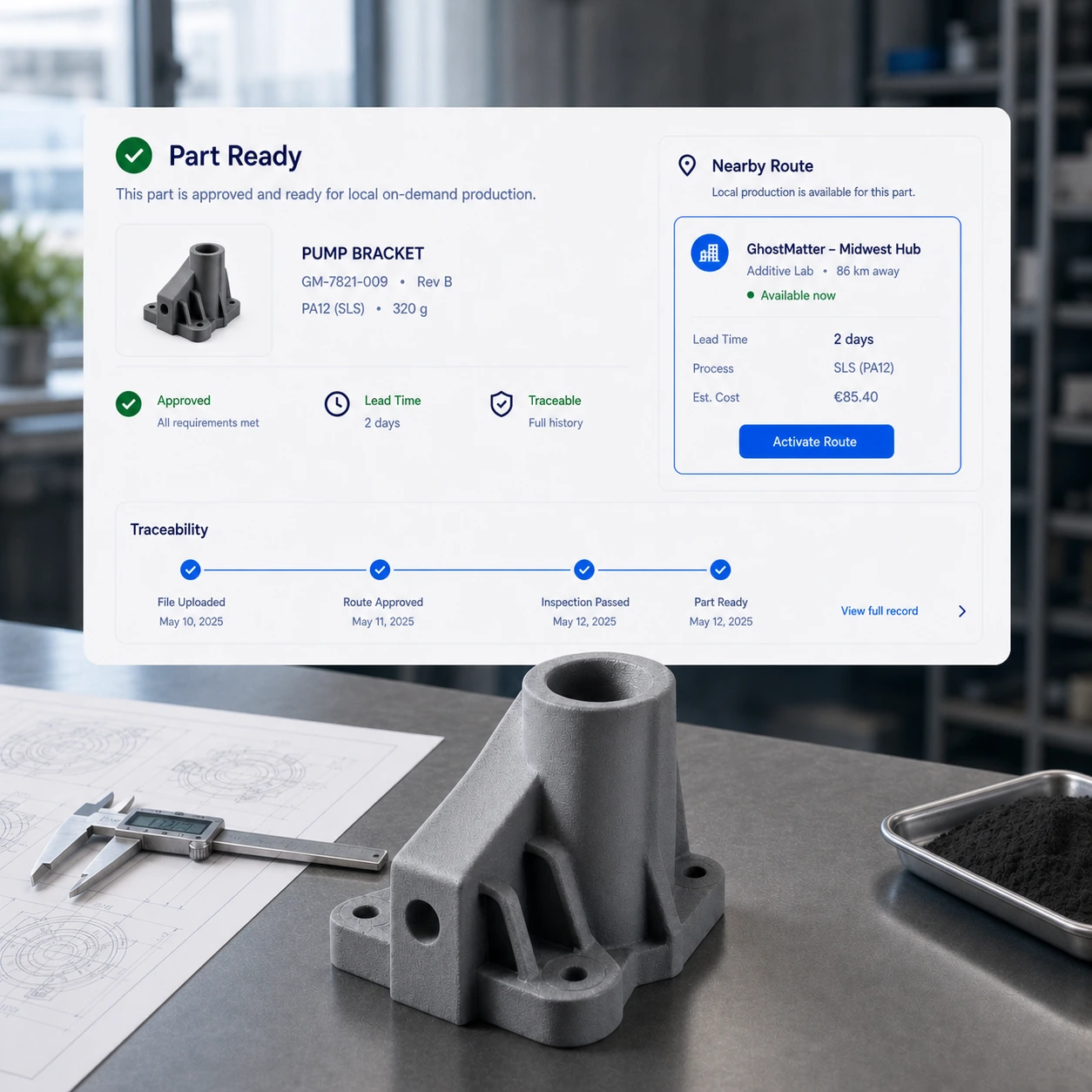
The fastest response is usually prepared in advance. GhostMatter helps identify which part records are ready enough to activate locally when a business need appears.
Use nearby capacity when proximity can reduce delay, response time or logistics friction.
Keep the digital inventory asset, readiness rules and route context ready before activation.
Connect each local execution to the approved file, request, route and quality record.
GhostMatter frames local on-demand production as manufacturing a part from its governed digital record through nearby qualified production capacity.
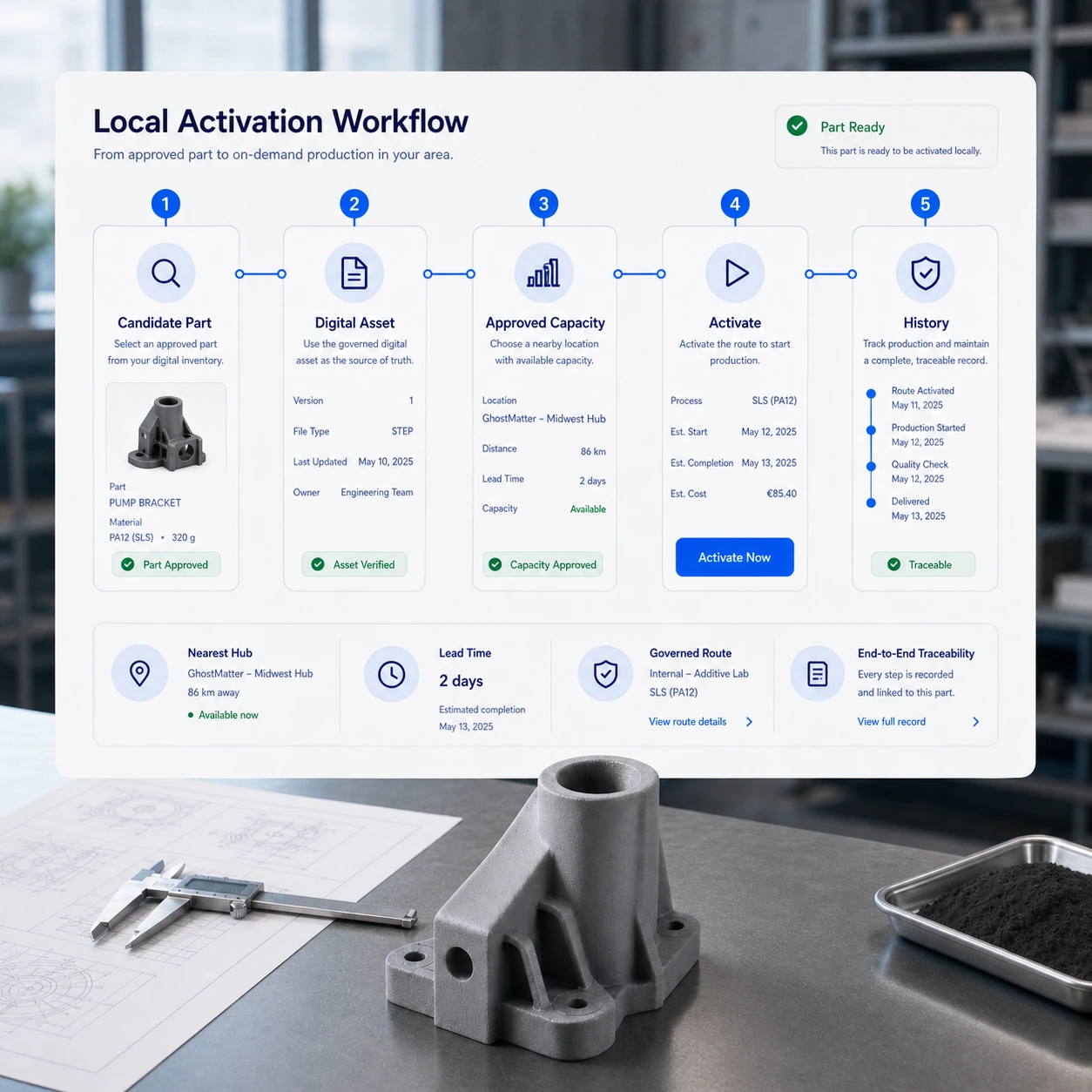
The value is strongest when demand is uncertain but the cost of waiting is high.
Move from visible downtime risk to controlled production faster.
Explore emergency sourcingSupport field operations and distributed equipment fleets with nearby capacity.
Explore maintenancePrepare selected slow-moving references without stocking every part everywhere.
Explore spare partsActivate production only when the demand signal appears and the route is approved.
Explore low-volume partsMany industrial references are hard to forecast. Keeping every item physically stocked is expensive; not stocking them creates downtime risk. Local on-demand production creates a third option for selected parts.
Identify urgent, slow-moving, obsolete, low-volume or regionally sensitive references.
Structure files, drawings, metadata, readiness rules and access rights.
Connect the part to qualified local partners or internal capacity when the route is suitable.
Trigger production only when the operational need is visible and the route is controlled.
Record production location, route, execution data and quality context for future TCO and impact evidence.
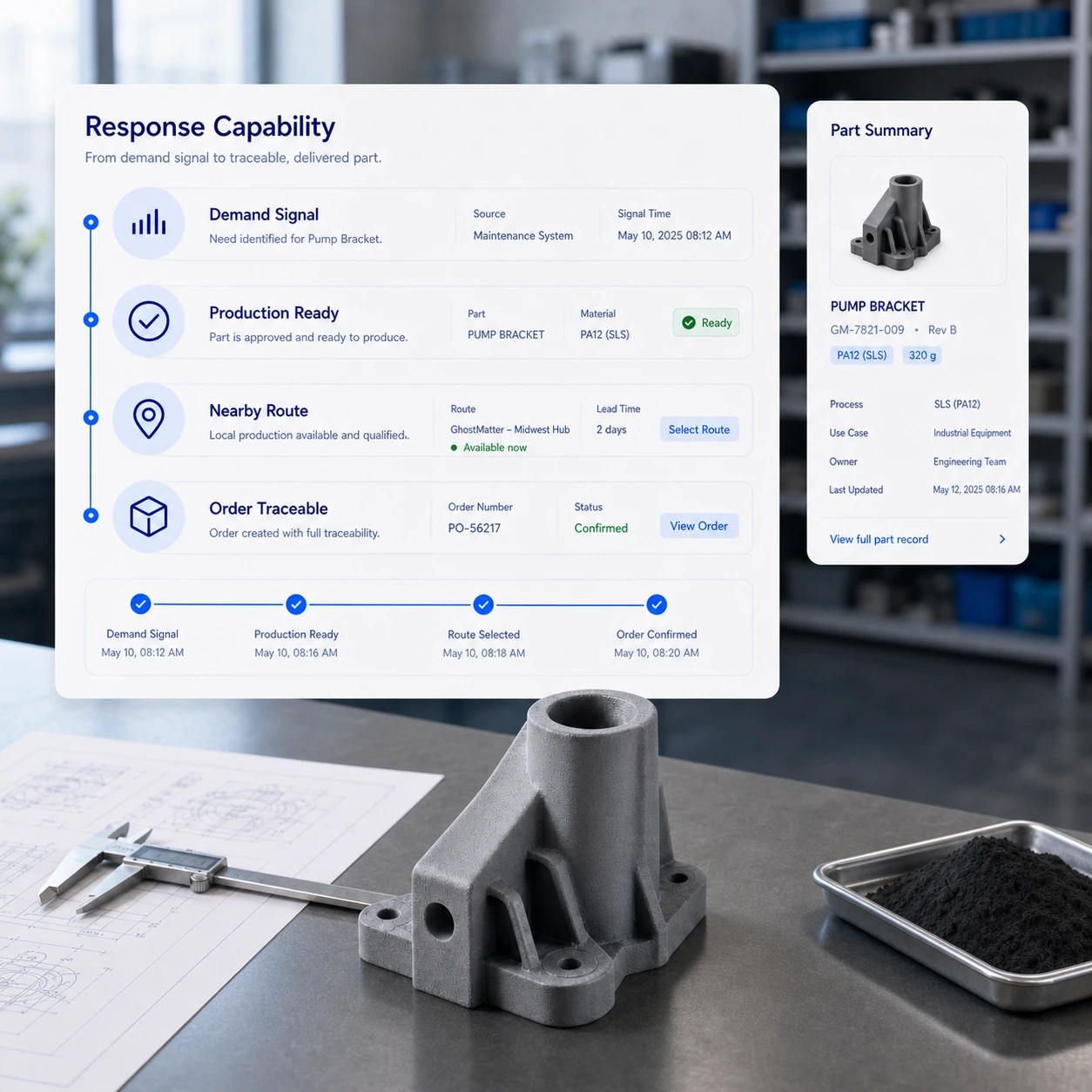
Local production can create useful data inputs for sustainability work, but claims need a documented methodology. GhostMatter's stronger role is to capture the routing and production history required for credible indicators.
Record where production happened and how that route compares to a baseline sourcing pattern.
Track where selected parts can remain digital until demand appears instead of being stocked everywhere.
Use route, production and order history as inputs before publishing CO2e or impact conclusions.
Local on-demand production depends on prepared assets, approved capacity and traceable execution.
Move from visible downtime risk to controlled production faster.
Explore emergency sourcingUse nearby qualified production partners when the route is approved.
Explore distributed manufacturingReduce the need to stock every slow-moving reference everywhere.
Explore inventory costsTrack routes and production history for future CO2e and TCO evidence.
Explore traceabilityThe best candidates combine uncertain demand, high waiting cost and an approved production route close enough to matter.
Use GhostMatter to prepare selected parts for local activation, so urgent, low-volume, or obsolete references can be produced through controlled workflows.
It is the production of selected parts closer to the point of need, triggered when demand becomes visible rather than produced and stored far in advance.
Not always. The business case depends on part criticality, inventory cost, lead time, production method, logistics and quality requirements.
By structuring the digital inventory asset, readiness rules, approved route, access rights and traceability before production is triggered.
It can provide data inputs, such as production location and routing history. Claims should be validated with a documented methodology before publication.